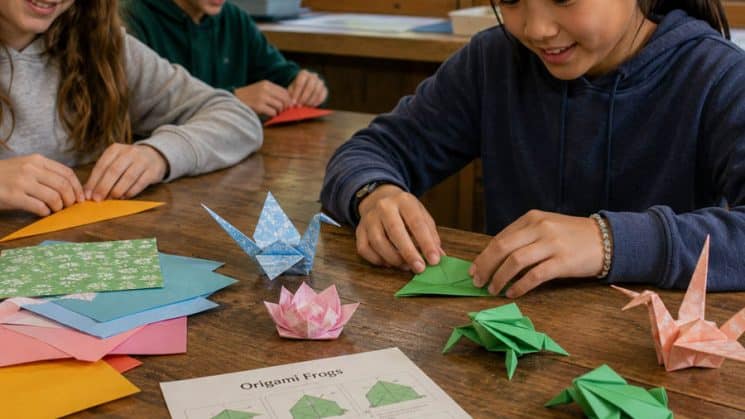
One sheet of paper. Infinite possibilities. Students discover the history, symbolism, and craft of Japanese origami, then put it all to the test in Frog Olympics!
What’s Covered
Students begin with a look at the history and cultural significance of origami, from its origins in Japan to the modern techniques introduced by Akira Yoshizawa. They’ll explore the symbolism behind different origami forms like cranes, frogs, and fish, then dive deeper into what those shapes have meant across generations. After free exploration with beginner models, the whole class follows along to fold an origami frog step by step. Then it gets competitive: students put their frogs to the test in Frog Olympics, with events like long jump, racing, and high jump. Every student takes their creation home.
Educational Standards
- 5.VA:Re7.2 — Identify and analyze cultural associations suggested by visual imagery.
- 6.VA:Cr2.1 — Demonstrate openness in trying new ideas, materials, methods, and approaches in making works of art and design.
- 6.VA:Re7.2 — Analyze ways that visual components and cultural associations suggested by images influence ideas, emotions, and actions.